
My first cruise was a transatlantic crossing — a honeymoon sailing from Barcelona to Miami. I didn’t know what to expect. What I remember most from that first day onboard is stepping into the atrium and just stopping. The scale of the ship, the height of the interior, the water park visible from the upper deck — it was nothing like I’d imagined a cruise would be.
Five cruises later — Mediterranean, Caribbean, Mexican Riviera, and that first Atlantic crossing — I keep booking them. Here are the six reasons why, based on what I’ve actually experienced rather than what cruise brochures tend to promise.

Why Travel by Cruise Ship? 6 Honest Reasons
1. You Unpack Once and Wake Up Somewhere New Every Day
This sounds like a small thing until you’ve done a multi-destination trip the conventional way — different hotel every two nights, bags in and out of taxis, checking in and out, remembering which city your jacket is in. A cruise eliminates all of that. You unpack once, into your own cabin, and the ship moves while you sleep.
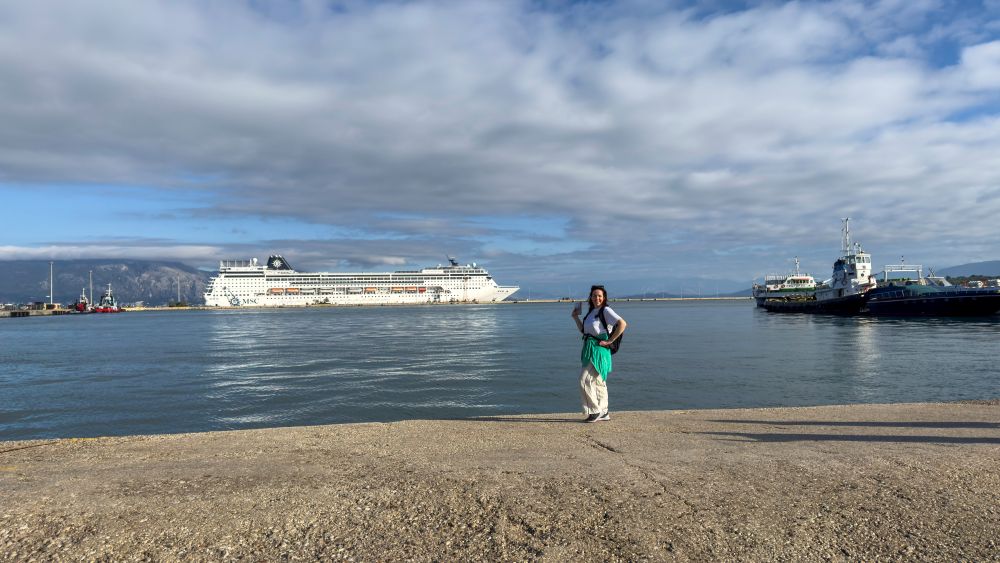
On our Mediterranean sailing aboard the MSC Fantasia, we visited six ports in eight days — Rome, Genoa, Marseille, Valencia, Tarragona, Naples. Six destinations without once dragging luggage through a train station or hunting for a taxi at an unfamiliar airport. Every morning we stepped off the ship into a new city, and every evening we came back to the same cabin, the same bed, the same routine.
For anyone who travels regularly, the logistics of multi-destination trips are exhausting. A cruise removes almost all of it. That convenience alone is worth a lot.

2. You See More in Less Time
This is the reason I’d give anyone who asks why we keep choosing cruises over other types of travel. The density of experience — the number of genuinely different places you can visit in a single two-week trip — is hard to match any other way.
On our transatlantic crossing, we stopped in Tenerife, Lanzarote, Saint Martin, the British Virgin Islands, and Puerto Rico before arriving in Miami. Stops we would never have prioritised as standalone destinations turned out to be some of the best days of the trip. The British Virgin Islands, Puerto Rico’s El Yunque rainforest, the volcanic landscapes of Lanzarote — none of these were on our original travel list. The cruise put them in front of us.
Seven hours per port isn’t long, and if deep cultural immersion in a single city is what you want, a cruise isn’t the right format. But for seeing a lot, covering real ground, and discovering places you wouldn’t have planned independently — nothing else comes close.
3. Almost Everything Is Included in the Price
Cruise lines describe themselves as all-inclusive, which isn’t entirely accurate — drinks, Wi-Fi, excursions, and gratuities are all extra. But the base fare covers more than most people realise: your cabin, all main meals (buffet and main dining room), evening shows, live music, pools, gym, and daily housekeeping. For a week or two, that’s a significant amount of your holiday cost already covered.
The value becomes most visible when you calculate the daily rate. On our Discovery Princess Mexican Riviera sailing, we paid $1,605 for two people in a balcony cabin for seven nights — roughly $100 per person per night, including accommodation, three meals a day, entertainment, and daily housekeeping. For a comparable standard on a land-based trip across multiple cities, that price doesn’t exist.
The honest caveat: budget for extras — drinks, shore excursions, and gratuities add up faster than most first-timers expect.

4. There Is Always Something to Do — or Nothing, If You Prefer
The thing I didn’t expect from cruising — and what became one of my favourite parts — is how much the ship itself becomes the experience on sea days. When you’re crossing the Atlantic and there’s no port for six consecutive days, the ship needs to hold your attention. And it does.
On the MSC Seashore transatlantic crossing, the water park on the upper deck was one of the genuine highlights of the voyage — something I wouldn’t have predicted before boarding. The slides were excellent, the queues were short in the morning, and using a water park in the middle of the Atlantic Ocean is a specific kind of absurd fun. Beyond that: evening theater productions that were genuinely good, live music throughout the day, trivia, dance classes, deck parties, outdoor movies.
But equally, on some sea days we did almost nothing. Sat on the balcony with coffee in the morning, read, walked the deck, had a long lunch. A cruise can be as full or as quiet as you want it to be, which is rare in any form of travel.
5. Cruises Work Exceptionally Well for Families
We’ve sailed with our daughter and with friends who had young children, and the cruise format handles mixed family groups better than almost any other type of holiday. The reason is simple: everyone can do what they want, and the group still comes together naturally.
On our MSC Fantasia Mediterranean sailing — two families, seven people including children aged 9, 10, and 18 — this played out exactly as I’d hoped. The younger children went to the pool and the water park. Our daughter had her evenings independently. The adults explored ports at their own pace. Everyone met for dinners and shows. Nobody had to compromise all the time, which in group travel is genuinely rare.
The buffet helps enormously with children. When kids can always find something familiar — pizza, chips, burgers — alongside the main offerings, mealtimes stop being a negotiation. For families with young children, this matters more than almost anything else on the ship.
6. Cruises Offer Genuine Value for Money
Cruises have a reputation for being expensive, and premium lines can be. But mainstream cruise lines — MSC, Princess, Royal Caribbean, Norwegian — offer a level of value that genuinely surprised me when I started calculating it properly.
Consider what a cruise fare actually covers: accommodation for every night of the voyage, all main meals, nightly entertainment, pools and gym access, and daily housekeeping. A transatlantic crossing that costs €2,155 for two people covers 17 nights of all of the above — roughly $63 per person per night. For a land-based trip covering six destinations in 17 days, $63 per person per night for accommodation alone would be exceptional.
The value is particularly strong on longer sailings and shoulder-season bookings. Our November transatlantic on the MSC Seashore was one of the best-value trips we’ve taken in terms of total experience per euro spent. October and November sailings on Mediterranean routes are similarly well-priced — the weather is still good, the ships are quieter, and the fares are noticeably lower than summer.
The key is budgeting honestly from the start — fare plus extras — rather than being surprised by the add-ons. Do that, and a cruise consistently delivers more experience per dollar or euro than most other travel formats.

Frequently Asked Questions
Is a cruise good value for money?
Yes — when you look at what the base fare covers: accommodation, all main meals, entertainment, pools, and housekeeping. On our 17-night transatlantic crossing we paid $2,155 for two — roughly $63 per person per night for all of that. The extras add up, but the base value beats comparable multi-destination land travel.
Is cruising good for first-time travellers?
It’s one of the easiest introductions to multi-destination travel — you book once, unpack once, and the logistics between cities are handled for you. For anyone nervous about unfamiliar transport or juggling hotel bookings, a cruise removes almost all of that complexity.
Are cruises suitable for families with young children?
Very much so. The buffet means children always find familiar food, kids’ clubs run all day, and from our experience travelling with children aged 9 and 10, the adults get genuine freedom while the kids stay happy. That’s the real test of a family holiday.
How many destinations can you see on a cruise?
Multi-port cruises typically visit four to eight destinations in seven to fourteen days. Our 8-day Mediterranean sailing covered six ports; our 17-day transatlantic stopped at five plus the start and end cities. It’s hard to cover that much ground any other way.
Is a cruise worth it for a honeymoon?
It was for us — our first cruise was a transatlantic honeymoon crossing. The mix of new destinations every few days and slow sea days in between gave us both adventure and downtime in one trip.
What surprised you most about cruising?
The scale and quality of the ship itself — we’d pictured something older and more formal, and found a well-run resort moving across the Atlantic.
Should You Try a Cruise?
If you’re a traveller who wants to see a lot, values convenience, and travels with a partner, family, or group with different interests — yes, try a cruise. The logistics are genuinely easier than any comparable multi-destination trip, the value is real when you calculate it properly, and the experience of waking up somewhere new every morning without having repacked your bag is something that doesn’t get old.
It’s not the right format for everyone — we’ve written honestly about the reasons a cruise might not be your dream vacation. If you travel primarily to spend a week in one place, go deep into a culture, and eat at local restaurants every night — a cruise’s pace will feel rushed and its food will disappoint. For that style of travel, a cruise is the wrong tool.
But if you want breadth, convenience, and genuine value — and you’re open to the idea that the ship itself can be as interesting as the ports — give it a try. Our honeymoon crossing turned us into repeat cruisers. Years later, we’re still booking.